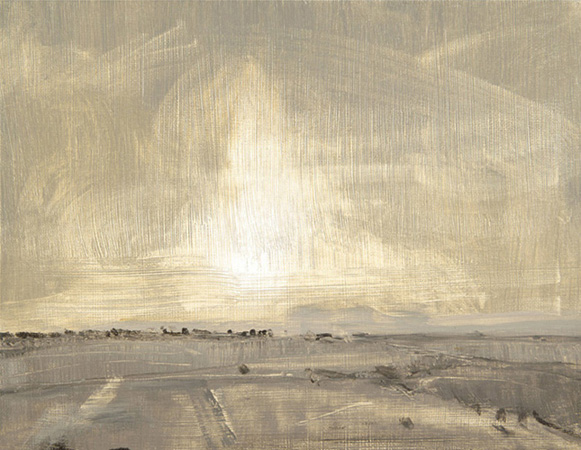
Painting outside ‘en plein air’ affords a spatial freedom. The feelings and thoughts that arise during the process of creating a landscape outside are subtly recorded within the painting in ways that reach beyond initial intentions of design or thought.
A main rationale of my painting is to capture the transience of life and our connection with nature. Open-air landscape for me is primarily a live interpretation, starting with an intuitive approach and an unexpected first-person narrative. This helps makes the work easily accessible to re-interpretations from a spectator. Even though much thought and feeling happens busily whilst I’m painting, the outcomes may often end up serene.
Some paintings remain pure open air works and some are finalised after many oscillations of process between site and studio.
Regularly painting at the same place improves fluency but it also adds a little coolness to the process; the first painting made at a new location is often heated-up by comparison.
Revisiting locations to paint on the same painting again, allows for the accumulation of further abstractions and rhythms, which are layered successively upon the surface over a number of days, recording changes in real time. My mind is always working but the gut and the heart play a strong role.
In the studio, the process becomes both experiential and reflective as methods are more thought-oriented. Further stages of destruction and creation take place, leading to new surface, visual devices, motifs and colour harmony. An evolving set of processes, partially formed from memory of the live locations and partially from the subsequent studio discoveries.
When I develop paintings in this way, many elements of the original on-site marks are partially buried but still remain visible enough such that they can be visually excavated.
Locations have included: The South Downs, Sussex woodlands & wetlands, The New Forest – Hampshire, Tuscan mountains, Alpilles Mountains, South of France, Avignon and Arles, Brittany, Arun Valley, Malvern Hills, Lindisfarne and Scotland.
Brush marks, layers and surface capture moments in time and duration. Some parts of the multi-layered compositions remain unpainted and abstract. The viewer’s eye is to be drawn on to the painting’s surface and back out, to see the whole painting. Here, I hope to invite close observation of the spatial interplay between a landscape painting’s imagery, its surface and the whole object on matters of: space, colour and complex experience.
 David Scott Moore - Landscape Painter